
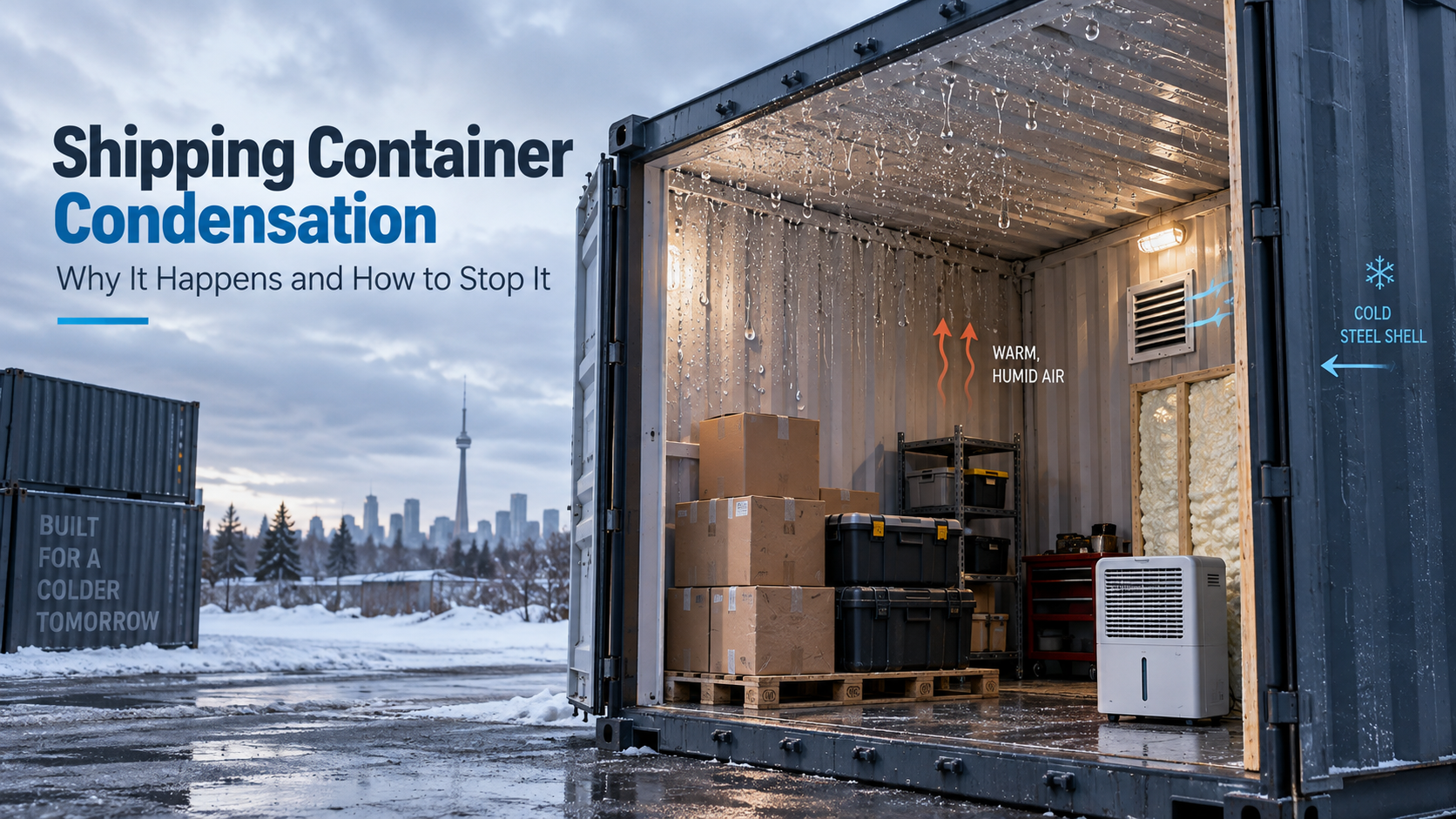
Shipping containers are built from durable steel and are designed to withstand harsh outdoor conditions. However, that same steel construction can create one common problem when a container is used for storage, a workshop, an office, or another long-term application: condensation.
Condensation inside a shipping container is sometimes referred to as container rain because moisture can collect on the ceiling and eventually drip onto the contents below.
In Ontario, large temperature swings between warm days, cool nights and cold winters can make condensation especially noticeable.
Fortunately, condensation can usually be controlled. The right solution depends on how the container is being used, what is being stored inside and whether the container will be heated or cooled.
Why Does Condensation Form Inside a Shipping Container?
Condensation occurs when warm, humid air comes into contact with a sufficiently cold surface. Natural Resources Canada explains that condensation commonly occurs during colder weather when moist indoor air contacts cooler surfaces.
A shipping container is essentially a large steel box. Steel transfers heat very quickly, so the walls and roof can become extremely cold during winter or overnight.
For example, the air inside a container may be relatively warm and humid while the exterior steel roof becomes cold. When that warm air touches the cold steel, water vapour turns into liquid water.
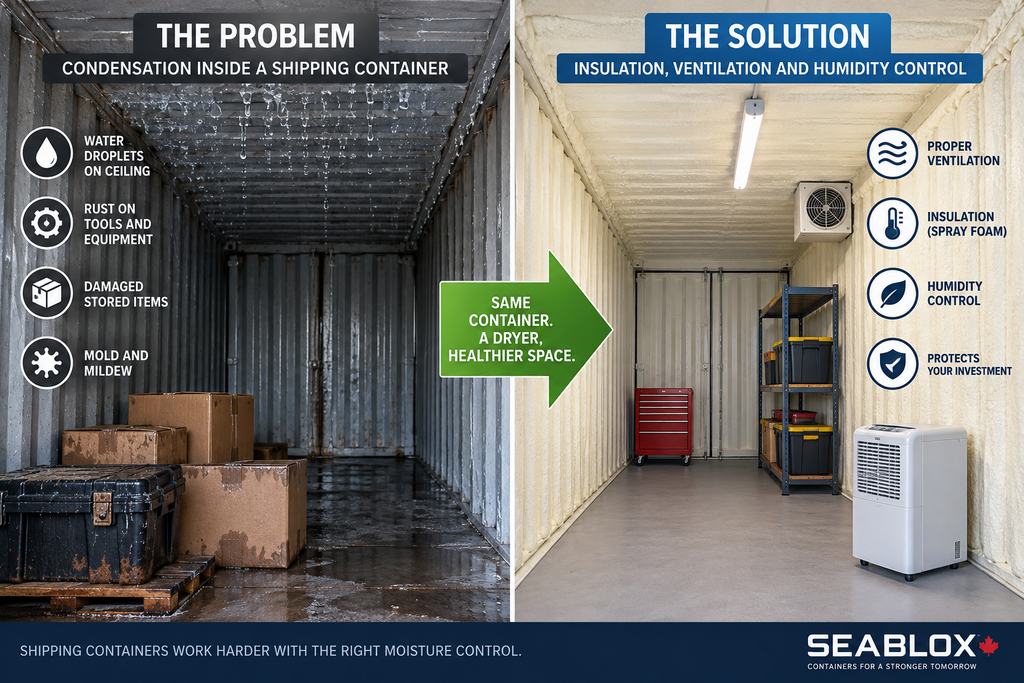
Moisture may appear as:
- Water droplets on the ceiling
- Damp walls
- Water dripping from the roof
- Wet floors
- Moisture around doors and framing
- Rust on tools or equipment
- Damp cardboard boxes
- Mold or mildew on stored materials
The container itself does not necessarily have to be leaking for water to appear inside.
What Is “Container Rain”?
Container rain occurs when condensation forms on the underside of the shipping container roof.
As moisture accumulates, droplets become large enough to fall onto the floor or whatever is being stored inside.
This can sometimes make it appear that the container roof is leaking even though no rainwater is entering from outside.
Container rain is more likely when there is:
- High humidity inside the container
- A large difference between indoor and outdoor temperature
- Limited ventilation
- Moisture-producing materials stored inside
- Frequent opening and closing of the container doors
- Heating without proper insulation
Ontario winters can make this problem more noticeable because the steel shell can become extremely cold while the interior remains warmer.
Where Does the Moisture Come From?
Before deciding how to control condensation, it helps to understand where the moisture is coming from.
Outside Air
Every time the container doors are opened, outside air enters the container.
During humid weather, this air may contain a significant amount of moisture.
When temperatures fall later in the day or overnight, some of that moisture can condense on the steel surfaces.
Wet or Damp Materials
Items brought into the container can introduce moisture.
Examples include:
- Wet construction equipment
- Snow-covered tools
- Lumber
- Landscaping equipment
- Vehicles
- Concrete or masonry products
- Wet clothing
- Recently washed equipment
Even materials that appear dry can slowly release moisture into the air.
Ground Moisture
Containers placed directly on wet soil or poorly drained areas may experience higher humidity around the underside of the container.
Proper site preparation and drainage can help reduce this issue.
People
For containers being used as offices, workshops or lunchrooms, people themselves produce moisture through breathing and normal daily activity.
Cooking, washing and certain industrial processes can add even more humidity.
How to Stop Condensation in a Shipping Container
There is no single condensation solution that is best for every container.
A basic storage container may only require ventilation, while a heated office or workshop will usually require insulation and climate control.
Here are the most common options.
1. Add Ventilation
Ventilation is one of the simplest ways to reduce humidity inside a shipping container.
Most newer shipping containers already have small factory vents, but additional ventilation may be beneficial depending on the application.
Common options include:
- Passive wall vents
- Louvered vents
- Roof vents
- Powered exhaust fans
- Intake and exhaust ventilation systems
Good ventilation allows humid air inside the container to be exchanged with outside air.
For general dry storage, additional vents can be an economical way to reduce moisture buildup.
However, ventilation alone is not always enough.
During very humid weather, outdoor air may contain just as much—or more—moisture than the air inside the container. In those conditions, simply bringing in more outside air may not solve the problem.
2. Install Closed-Cell Spray Foam Insulation
For containers that are being heated, cooled or occupied regularly, closed-cell spray foam insulation is one of the most effective ways to control condensation.
Closed-cell spray foam is sprayed directly onto the inside surface of the steel container.
This has several advantages.
It:
- Insulates the steel shell
- Reduces the temperature difference between the interior air and interior wall surface
- Limits warm, humid air from contacting cold steel
- Provides excellent air sealing
- Adds very little moisture to the assembly
- Works well around the corrugated shape of container walls
Because spray foam adheres directly to the steel, there is very little space for humid interior air to circulate behind the insulation.
For many container offices and workshops, approximately 2 inches of closed-cell spray foam is commonly used on the walls, with additional insulation sometimes installed at the ceiling depending on the application.
The appropriate thickness should be determined based on the intended indoor temperature, exterior climate and building requirements.
3. Use Proper Heating and Cooling
Heating a completely uninsulated shipping container can sometimes make condensation worse.
The heater warms the air inside the container, but the exterior steel remains cold. Warm air can hold more moisture, and when that warm air contacts the cold steel, condensation forms.
For heated containers, insulation should normally be part of the overall design.
For year-round offices, workshops and other occupied spaces, a heat pump or air-conditioning system can also help manage indoor temperature and humidity.
Mini-split heat pumps are frequently used in modified shipping containers because they can provide both:
- Heating
- Air conditioning
Air conditioning also removes moisture from the air while operating.
4. Use a Dehumidifier
A dehumidifier can be effective when a container has access to electricity.
The unit removes moisture directly from the indoor air and collects or drains the water.
Dehumidifiers can be especially useful for:
- Tool storage
- Equipment storage
- Archive storage
- Finished container interiors
- Workshops
- Seasonal moisture problems
For permanent installations, the condensate drain can often be routed outside so the unit does not need to be emptied manually.
Keep in mind that standard refrigerant dehumidifiers become less effective at very low temperatures. The operating temperature range of the selected unit should match the environment inside the container.
5. Use Moisture Absorbers or Desiccants
For smaller moisture problems, desiccant products can help absorb humidity.
Examples include:
- Silica gel
- Calcium chloride moisture absorbers
- Commercial container desiccant bags
These products can be useful when storing relatively dry goods in a sealed container.
However, they have a limited moisture capacity.
If large amounts of moisture are continuously entering the container, desiccants will need to be replaced regularly and should not be considered a substitute for proper ventilation, insulation or dehumidification.
6. Keep Water Out Before It Enters
Some condensation problems are actually a combination of condensation and water intrusion.
Before modifying the container, inspect it for:
- Damaged roof panels
- Door seal damage
- Rust holes
- Damaged welds
- Openings from previous modifications
- Poorly sealed windows or doors
- Improperly installed air conditioners
- Penetrations through the roof or walls
A shipping container should be watertight before attempting to solve an interior humidity problem.
7. Prepare the Site Properly
The location of the container can also affect moisture.
Containers should normally be placed on a stable, reasonably level surface with good drainage.
Common support options include:
- Concrete pads
- Concrete blocks
- Compacted gravel
- Engineered foundations
Keeping the container slightly elevated also allows air movement underneath the floor and prevents the container from sitting directly in water or saturated soil. For more information refer to our previous article on the subject.
Avoid areas where water regularly pools around the container.
Ventilation vs. Insulation: Which Is Better?
This depends primarily on how the shipping container will be used.
Basic Storage
For general storage of tools, equipment or weather-resistant materials, additional ventilation may be sufficient.
A few properly positioned intake and exhaust vents can help keep indoor and outdoor humidity levels more balanced.
Sensitive Storage
If you are storing materials that can be damaged by moisture, such as:
- Electronics
- Documents
- Furniture
- Clothing
- Certain construction materials
- Precision tools
ventilation may need to be combined with a dehumidifier or insulation.
Heated Storage or Workshops
If the container will be heated during winter, insulation becomes much more important.
Heating an uninsulated steel container creates a large temperature difference between the air and the container walls.
Closed-cell spray foam combined with controlled ventilation or dehumidification is usually a much better solution.
Shipping Container Offices
For an office, lunchroom, guard shack or other regularly occupied container, the container should be treated much more like a small building.
A typical design may include:
- Closed-cell spray foam insulation
- Interior framing
- Interior wall cladding
- Heating and air conditioning
- Ventilation
- Properly sealed doors and windows
- Electrical service
This creates a comfortable interior while significantly reducing condensation risk.
Does Plywood or Interior Cladding Stop Condensation?
No.
Installing plywood, PVC panels, drywall or steel interior cladding by itself does not solve condensation.
If warm interior air can travel behind the finished wall and reach cold exterior steel, condensation may still form where it cannot easily be seen.
This is one reason the insulation and air-sealing strategy behind the finished wall is so important.
Hidden condensation can eventually contribute to:
- Mold
- Rust
- Damaged wood framing
- Odours
- Wet insulation
Hidden condensation can eventually contribute to mould, damaged wood framing, odours and deterioration of interior materials. Health Canada notes that moisture can accumulate when it cannot be adequately vented and that condensation on cold surfaces is one potential source of indoor moisture problems.
The moisture-control system should therefore be designed before interior cladding is installed.
Can Shipping Containers Rust From Condensation?
Yes.
Shipping containers are made from corrosion-resistant weathering steel, commonly referred to as Corten steel, but they are not immune to corrosion.
Repeated exposure to moisture can eventually cause rust, particularly where coatings have been damaged or where water remains trapped for long periods.
Condensation behind wall finishes can be especially problematic because the moisture may remain unnoticed.
Controlling moisture helps protect both the container and the items stored inside it.
What Is the Best Way to Prevent Shipping Container Condensation?
For many applications, the best solution is a combination of moisture-control methods rather than relying on only one.
For a simple storage container, this may mean:
Good site drainage + additional ventilation
For sensitive storage:
Ventilation + dehumidification
For a heated workshop:
Closed-cell spray foam + heating + controlled ventilation
For a finished office:
Insulation + HVAC + ventilation + proper air sealing
The correct setup depends on the intended use of the container.
Shipping Container Insulation and Modifications in Ontario
At Seablox, we supply and modify shipping containers for commercial, industrial and residential applications throughout Ontario.
Containers can be customized with features such as:
- Closed-cell spray foam insulation
- Interior framing
- Plywood, PVC or metal interior finishes
- Windows
- Personnel doors
- Roll-up doors
- Electrical systems
- Lighting
- Heating
- Air conditioning
- Mini-split heat pumps
- Passive vents
- Powered ventilation
- Custom openings and fabrication
Planning for condensation before completing the interior of the container can prevent moisture problems and help protect the container for years to come.
If you’re planning a shipping container project and aren’t sure how much insulation or ventilation you need, contact Seablox to discuss the intended use of your container and the available modification options.
Frequently Asked Questions
Why is there water dripping from the ceiling of my shipping container?
If the container roof is not leaking, the most likely cause is condensation. Warm, humid air is contacting the cold steel roof, causing water droplets to form. When enough water accumulates, the droplets fall from the ceiling. This is often called container rain.
Do shipping container vents stop condensation?
Vents can significantly reduce condensation in many storage applications by allowing humid air to escape. However, ventilation does not eliminate condensation in every situation, particularly if the container is heated or outside humidity is high.
Should I insulate a shipping container?
If the container will be heated, air conditioned or regularly occupied, insulation is generally recommended. Insulation also helps control condensation by preventing indoor air from contacting extremely cold or hot steel surfaces.
What insulation is best for a shipping container?
Closed-cell spray foam is commonly used because it adheres directly to the corrugated steel, provides insulation and air sealing, and helps reduce the opportunity for condensation to form behind the insulation.
Will a dehumidifier work inside a shipping container?
Yes. A properly sized dehumidifier can be very effective, particularly in enclosed storage containers with electrical power. The unit’s operating temperature range should be appropriate for the conditions inside the container.
Why does my shipping container sweat in winter?
The steel shell becomes cold during winter. Warm, humid interior air then contacts the cold steel and cools below its dew point, causing water to form on the walls or ceiling.
Can I heat a shipping container without insulating it?
You can, but it is generally inefficient and can increase condensation problems. For a container that will be heated regularly, insulating the shell first provides better temperature control and reduces the risk of condensation.