
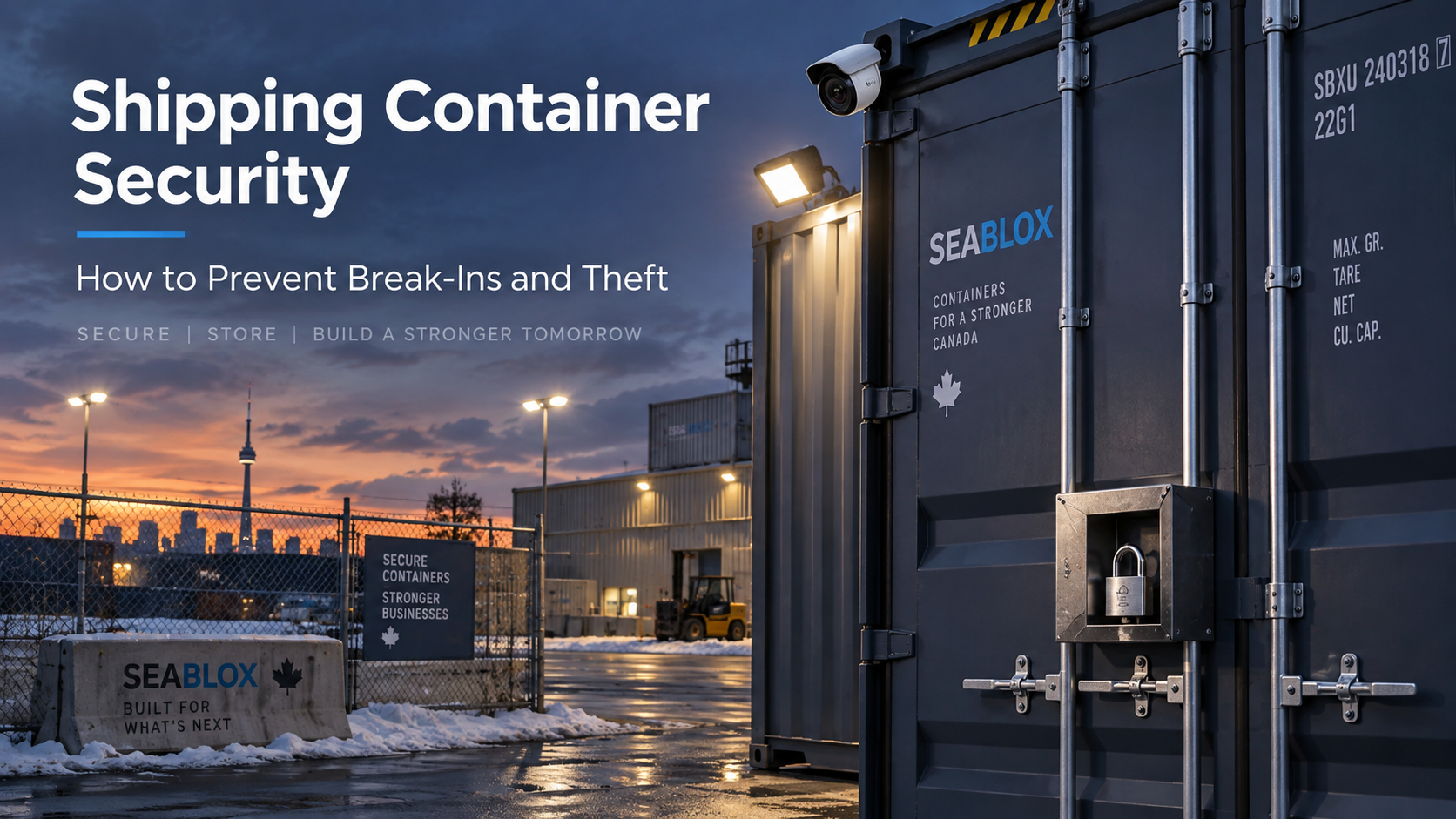
Shipping containers are widely used for secure storage on construction sites, commercial properties, industrial yards and residential properties. Their heavy steel construction and cargo doors make them significantly more difficult to access than a typical shed—but that does not mean a shipping container is automatically theft-proof.
Good shipping container security depends on more than simply putting a padlock on the doors.
The strongest approach combines a quality container lock, a protected lockbox, good site placement, lighting, cameras and basic access-control practices. For containers holding expensive tools, machinery or inventory, using several layers of security can make unauthorized entry considerably more difficult and increase the chance that suspicious activity is noticed.
This guide explains practical ways to prevent shipping container break-ins and theft, particularly for containers used on job sites, commercial properties and storage yards in Canada.
Are Shipping Containers Secure?
A standard ISO shipping container starts with several major security advantages.
It has:
- Heavy corrugated steel walls
- Steel cargo doors
- Multiple locking rods
- Limited access points
- A steel frame designed for demanding transportation environments
Unlike a shed or light commercial storage building, there are relatively few obvious entry points.
However, the security of the container ultimately depends on its weakest component.
On an unmodified container, that is often the locking system.
A strong steel door offers limited protection if the padlock securing it is inexpensive, exposed and easily accessible.
For that reason, one of the first upgrades to consider is a shipping container lockbox combined with a heavy-duty container lock.
1. Use a Shipping Container Lockbox
A lockbox is one of the most useful security upgrades available for a standard shipping container.
A shipping container lockbox is a heavy steel enclosure installed around the padlock area of the cargo doors. Instead of leaving the entire lock exposed, the lockbox surrounds it and limits access to the locking mechanism.
This makes it considerably more difficult to reach the lock with large cutting or striking tools.
Many newer one-trip shipping containers already include a factory-installed lockbox. Older used containers may not.
If you have a container without one, a lockbox can normally be added as a relatively simple modification.
For maximum benefit, pair the lockbox with a properly sized, good-quality lock designed for container use.
Seablox offers a heavy-duty shipping container lock specifically designed to fit inside standard container lockboxes.
Why Is a Lockbox Better Than an Exposed Padlock?
The purpose of a lockbox is not simply to add more steel.
Its main advantage is that it reduces access to the lock itself.
Even a strong padlock becomes more vulnerable when its body and shackle are completely exposed. A properly designed lockbox leaves considerably less working room around the lock.
For storage containers holding tools, equipment or commercial inventory, we strongly recommend using a lockbox rather than relying on an exposed padlock alone.
2. Choose the Right Shipping Container Lock
Not all padlocks offer the same level of protection.
Small general-purpose padlocks designed for lockers, gates or household use are usually not the best choice for an outdoor shipping container.
Look for a heavy-duty lock with:
- Hardened steel construction
- Limited exposed shackle area
- Corrosion-resistant components
- A size compatible with your lockbox
- A locking mechanism intended for outdoor use
Canadian weather is another consideration.
The lock may be exposed to rain, snow, freezing temperatures, road salt and repeated freeze-thaw cycles. A lock that begins sticking or corroding after one winter can quickly become both a security problem and an inconvenience.
The Seablox Shipping Container Lock is designed for standard container lockboxes and outdoor applications.
Whatever lock you choose, inspect it periodically and replace it if it becomes heavily corroded, damaged or unreliable.
3. Use More Than One Layer of Security
A common mistake is thinking about container security as a single product.
A strong lock helps, but the best security system uses multiple layers.
For example:
Layer 1: Container cargo doors and locking rods
Layer 2: Lockbox and heavy-duty lock
Layer 3: Controlled access to the property
Layer 4: Exterior lighting
Layer 5: Cameras or alarms
Layer 6: Inventory records and identification
Each layer creates another obstacle.
This principle is similar to Crime Prevention Through Environmental Design (CPTED), which focuses on reducing opportunities for crime through visibility, access control and thoughtful property design.
The RCMP recommends measures such as improved lighting, clear sight lines, locks, fences and controlled property boundaries as ways of reducing opportunities for property crime. You can read more in the RCMP’s property crime prevention guidance.
4. Place the Container Where It Can Be Seen
Where you put the container can have a surprisingly large effect on security.
A container hidden behind a building, vegetation or equipment may give someone more privacy to attempt unauthorized entry.
When possible, position storage containers where they are visible from:
- Offices
- Occupied buildings
- Main entrances
- Public or internal roads
- Security cameras
- Other active areas of the property
Visibility creates what security professionals often refer to as natural surveillance.
The RCMP specifically recommends maintaining clear sight lines and reducing hiding places as part of CPTED crime-prevention practices.
This does not mean your container has to sit directly beside the road. The goal is simply to avoid creating a secluded area where someone can work unnoticed.
5. Install Exterior Lighting
Lighting is one of the simplest ways to improve security around a shipping container.
For containers located in commercial yards or construction sites, consider illuminating:
- Cargo doors
- Personnel doors
- Approaches to the container
- Gates
- Parking areas
- Paths between buildings and containers
Motion-activated lights can be particularly useful in areas that do not need to remain illuminated all night.
The RCMP recommends LED or motion-sensor lighting around properties because improved visibility can discourage criminal activity and make suspicious behaviour easier to observe. Read the RCMP’s additional property-security recommendations.
For remote container locations where utility power is unavailable, solar-powered security lighting may also be an option.
6. Consider Security Cameras
Cameras provide both deterrence and useful evidence if an incident occurs.
A camera system around a shipping container should ideally cover more than just the doors.
Consider capturing:
- The container entrance
- Vehicles approaching the property
- Licence plates where practical
- Gates and access roads
- Adjacent storage areas
Position cameras high enough that they cannot easily be reached from ground level.
For remote sites without internet access, there are camera systems that record locally or use cellular connections.
Even when cameras are installed, they should complement—not replace—physical security.
The RCMP includes exterior cameras among the measures property owners can consider as part of a broader property-crime prevention strategy.
7. Secure the Entire Property
If someone can drive directly up to a container unnoticed, even an excellent lock is being asked to do all the work.
Where practical, secure the surrounding site with:
- Fencing
- Locked gates
- Vehicle barriers
- Controlled entrances
- Security lighting
- Cameras
For construction sites, equipment yards and industrial properties, controlling vehicle access can be particularly important.
A fence does not need to make a site impossible to enter to be useful. It establishes a clear boundary and adds another barrier before someone can reach the container.
RCMP CPTED guidance similarly identifies fences and closed gates as useful ways of establishing property boundaries.
8. Don’t Advertise What’s Inside
Security also involves reducing unnecessary information.
If a container holds expensive tools, generators, welding equipment or inventory, avoid leaving those items visible while the doors are open when unnecessary.
Similarly, avoid labelling the outside of a storage container with detailed descriptions of valuable contents.
On construction sites, consider keeping particularly expensive portable equipment farther inside the container rather than immediately beside the cargo doors.
The steel shell may be identical whether a container holds $500 worth of supplies or $100,000 worth of equipment. There is rarely a reason to make that difference obvious from outside.
9. Keep an Inventory of Valuable Equipment
Physical security helps prevent theft. Good records help if theft still occurs.
Maintain a basic inventory of valuable items stored in your container, including:
- Make and model
- Serial number
- Purchase date
- Photographs
- Receipts
- Identifying marks
This is particularly important for power tools, generators, welders, compressors and other portable equipment.
RCMP security guidance recommends keeping records such as photographs, serial numbers and receipts for valuable property because these details can assist with identification if items are stolen.
For businesses, maintaining an equipment register can also make it easier to identify missing items quickly.
10. Inspect Cargo Doors and Locking Hardware
Locks are only useful when the doors and hardware around them are in good condition.
Periodically inspect:
- Locking rods
- Door handles
- Hinges
- Lockbox
- Padlock
- Door frame
- Welded security components
Look for excessive corrosion, damaged welds, bent hardware or evidence of attempted tampering.
Cargo door mechanisms should operate smoothly enough that employees do not begin leaving containers partially secured because the doors have become difficult to use.
If the doors suddenly become significantly harder to open or close, the problem may not actually be the doors.
A container that has settled unevenly can twist slightly and cause the cargo doors to bind. Proper site preparation and leveling are therefore important for both usability and security.
Seablox explains the different options in our guide to shipping container bases, including gravel and concrete.
11. Pay Extra Attention to Modified Shipping Containers
Once a shipping container is modified, the original cargo doors may no longer be its weakest point.
Adding a:
- Personnel door
- Window
- Roll-up door
- Concession opening
- Vent
- Access hatch
creates additional openings that need to be considered as part of the security design.
For example, a standard residential-style personnel door may not provide the same physical protection as the original steel cargo doors.
For commercial or industrial containers, consider steel personnel doors, commercial-grade locking hardware and properly reinforced frames.
Windows can be fitted with security glazing, shutters or protective bars where appropriate.
However, any security modifications to an occupied container must take required emergency exits and local building or fire-code requirements into account. Security measures should never trap occupants inside the container.
Seablox provides complete shipping container modification services including doors, windows, roll-up doors, electrical systems, HVAC and custom fabrication.
12. Secure Roll-Up Doors Properly
Roll-up doors are popular additions because they make it much easier to move large equipment, pallets and materials into a shipping container.
However, they have a different locking system than traditional container cargo doors.
Choose a roll-up door with robust locking hardware and use an appropriate lock whenever the container is unattended.
For high-value storage, the quality of the door frame is also important. The opening should be properly reinforced so that adding the door does not unnecessarily compromise the container structure.
Seablox supplies and installs shipping container roll-up doors in several sizes, complete with framed openings and locking hardware.
13. Don’t Forget Rental Containers
Rental shipping containers are frequently used on construction sites, renovations and temporary commercial projects.
These situations can actually create greater security concerns because the container may contain a constantly changing collection of tools and materials while being located on a temporary site.
Even for short-term rentals, consider:
- A quality lock
- A lockbox
- Good lighting
- Camera coverage
- Controlled site access
Seablox offers shipping container rentals and accessories for construction, equipment storage, renovations and commercial applications throughout Ontario.
Can Someone Break Into a Shipping Container?
Given enough time, tools and privacy, virtually any physical structure can be breached.
The goal of good shipping container security is therefore not to claim that a container is impossible to enter.
The goal is to make unauthorized access:
More difficult, more time-consuming, more visible and less attractive.
A container with exposed locks in a dark, isolated corner of an unsecured property presents a very different opportunity than a container protected by a lockbox, quality lock, lighting, cameras and controlled access.
That is why layered security is so important.
What Is the Best Lock for a Shipping Container?
For most standard cargo containers, one of the best configurations is a heavy-duty lock installed inside a steel lockbox.
The lockbox protects the lock from direct access, while the lock secures the cargo doors.
If purchasing a new container, look for a unit that already includes a factory-installed lockbox.
If purchasing a used container without one, ask whether a lockbox can be installed before delivery.
You can view the Seablox Shipping Container Lock or browse our complete range of shipping container accessories.
Shipping Container Security Checklist
Before leaving your container unattended, check the following:
- Cargo doors are fully closed
- Locking rods are correctly engaged
- Heavy-duty lock is installed
- Lockbox is secure
- Personnel doors and windows are locked
- Roll-up doors are secured
- Exterior lighting is functioning
- Cameras have a clear view
- Gates and perimeter fencing are secured
- High-value equipment is recorded by serial number
- Keys are controlled and accounted for
For commercial sites, it is worth assigning responsibility for the final security check at the end of each workday.
Frequently Asked Questions About Shipping Container Security
Are shipping containers hard to break into?
Shipping containers are inherently strong because of their steel construction and heavy cargo doors. However, security depends heavily on the lock, lockbox, modifications and surrounding property. A strong container with a weak exposed padlock can still be vulnerable.
Do I need a lockbox on a shipping container?
A container can be locked without a lockbox, but a lockbox is strongly recommended for valuable storage. It shields much of the lock from direct access and provides an additional physical barrier against tampering.
Do new shipping containers come with lockboxes?
Many modern one-trip containers are supplied with factory lockboxes, although specifications vary. Confirm the exact features before purchasing.
Can a lockbox be added to a used shipping container?
Yes. Lockboxes can typically be installed on used containers that do not already have one.
Are shipping containers good for tool storage?
Yes. Their steel construction, weather resistance and limited entry points make containers popular for tool and equipment storage. For expensive equipment, combine the container with appropriate locks, lighting, cameras and site access controls.
Should I install cameras around my shipping container?
For containers holding valuable equipment or inventory, cameras are an excellent additional layer of security. They can act as a deterrent and provide evidence if suspicious activity or a break-in occurs.
Final Thoughts: Improving Shipping Container Security
Shipping containers provide an excellent starting point for secure storage, but effective shipping container security requires more than steel walls.
Start by protecting the cargo doors with a quality lock and lockbox. Then consider the entire environment around the container: lighting, visibility, cameras, fencing, gates and who has access to the site.
For high-value commercial or construction storage, use several layers rather than relying on one security measure.
And if you are modifying a shipping container, think about security during the design stage. Personnel doors, windows and roll-up doors can all be designed with security in mind before the container reaches your site.
Seablox supplies new and used shipping containers, rentals, locks, accessories and custom container modifications throughout Ontario.
Browse our shipping containers and accessories, learn more about our container modification services, or contact Seablox to discuss a secure storage or custom container solution.